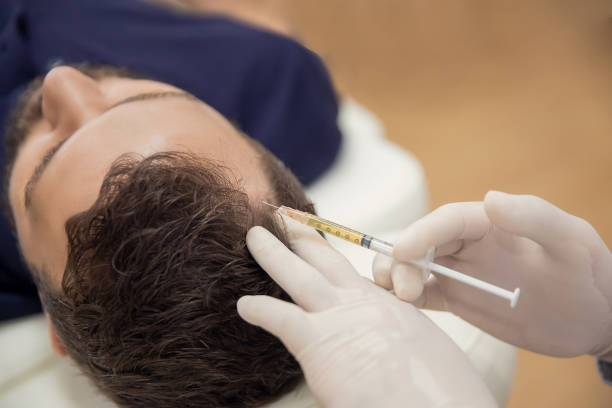
PRP therapy treatment for hair loss
Mar 29, 2023
PRP therapy is a popular hair treatment procedure that is beneficial for a new patient as well as a patient who has done other hair fall remedy treatments like a hair transplant. For a hair transplant, PRP is a supplementary procedure that most expert dermatologists recommend.
PRP (platelet-rich plasma) treatment is a medical procedure in which a patient's own blood is used to create a concentrated solution of platelets, which are then re-injected into the patient's scalp to promote healing and tissue regeneration.
The development of PRP (platelet-rich plasma) treatment has evolved over time, with early uses in dentistry and orthopedics, followed by its application in other medical fields such as plastic surgery, wound healing, and hair restoration.
In the late 1970s, PRP treatment was first used in dentistry to promote bone growth and healing in dental procedures. The treatment was then introduced to orthopedics in the 1990s, where it was used to treat injuries to the musculoskeletal system, such as ligament or tendon tears.
PRP treatment for hair loss started to gain popularity in the early 2000s. Researchers found that the growth factors present in platelets can stimulate the production of new cells, including hair follicle cells. Many studies have been conducted to investigate the effectiveness of PRP treatment for hair loss and restoration.
Over the years, researchers have developed new techniques for preparing and administering PRP, as well as new methods for measuring its effectiveness. The development of more sophisticated equipment and processing methods has led to the production of more concentrated and pure PRP.
PRP is becoming popular in Nepal in recent years as an effective and affordable treatment to control hair loss. The frontline dermatologists, trichologists, and hair clinics offer PRP therapy in major cities such as Kathmandu. Many people have benefited from the treatment, and the crowd is getting bigger.
It is typically used in conjunction with other hair transplantation procedures such as FUE and DHI methods. During the hair transplant procedure, the surgeon will first extract hair follicles from the patient's scalp and then carefully transplant them to the areas of the scalp where hair loss is occurring. The PRP treatment is then applied post-surgery to promote the healing and regeneration of the transplanted follicles.
How does Platelet Rich Plasma(PRP) therapy work?
Platelet Rich Plasma(PRP) is blood plasma consisting of a higher concentration of platelets than the normal circulating blood.
Plasma is the liquid part of blood. 50-55% of blood volume is covered by plasma. The other components of blood - Red blood cells(RBC), White blood cells(WBC), and platelets are suspended in the plasma when the blood circulates throughout the body.
Centrifugation is a process of separation of molecules having different densities by rotating the solution in a centrifuge rotor at a very high speed. RBC, WBC, Platelets, and plasma in blood have different densities. In the PRP treatment procedure, when the blood is centrifuged at a definite speed, the components of the blood separate into different layers according to their density. The layer of RBC is separated and the layer of concentrated platelets with plasma is collected in a different tube which is called Platelet-rich-plasma(PRP).
Platelets (also known as thrombocytes) are small, disc-shaped cell fragments that are found in the blood. They are produced in the bone marrow and are released into the bloodstream.
Platelets help in the clotting of blood to stop bleeding. They also contain growth factors that play a key role in the body's healing process by bringing extra oxygen, collagen, and other elements to repair the damaged tissues. In PRP, the platelets are specially collected and injected into the treatment area for their growth factors, which are proteins that promote cell growth, division, and differentiation.
There are several growth factors in platelets that are believed to stimulate hair growth, including:
- Platelet-derived growth factor (PDGF)
- Vascular endothelial growth factor (VEGF)
- Transforming growth factor-beta (TGF-beta)
- Insulin-like growth factor 1 (IGF-1)
- Keratinocyte growth factor (KGF)
- Fibroblast growth factor 7 (FGF7)
- Epidermal growth factor (EGF)
These growth factors promote the growth and development of blood vessels, thus improving blood flow to the scalp, and nourishing the hair follicles which leads to the growth of denser, stronger, and healthier hair.
Should I get PRP therapy for my hair loss?
Yes. You can benefit from PRP therapy if you are worried about your thinning hair and want to control your hair loss. PRP can be your way to go, to prevent further hair loss and regain thicker, stronger hair. It is often used to treat androgenetic alopecia, also known as male or female pattern baldness.
PRP is also used in combination with other hair loss treatments such as hair transplantation or medications like finasteride and minoxidil.
PRP treatment may not be suitable for individuals who have:
- A history of blood clotting disorders
- History of anemia
- A history of cancer
- A history of keloid scarring
- A history of skin diseases such as psoriasis or eczema on the scalp
- Pregnant or breastfeeding
You should consult with a certified dermatologist if PRP hair treatment is appropriate for you. S/he will evaluate your medical history, hair loss condition, and overall health to determine if PRP is the best treatment option for you.
How is PRP hair treatment done?
The procedure for PRP (platelet-rich plasma) therapy typically begins with a consultation with a medical professional, such as a dermatologist or hair restoration specialist. During the consultation, the doctor will assess the patient's hair loss and overall health to determine if PRP therapy is a suitable treatment option. Next, you can directly go for the procedure on the selected date without any prior admission.
The procedure typically involves the following steps:
- Blood is drawn from the patient, usually from the arm.
- The blood is placed in a centrifuge and rotated at a speed of 3000-6000 revolutions per minute(RPM) to separate and concentrate the Platelet Rich Plasma(PRP) from other blood components.
- The concentrated plasma, which is rich in platelets, is then collected and prepared for injection.
- The doctor will prepare the patient's scalp by cleaning it and then administer local anesthesia to numb the area.
- The PRP is then injected into the scalp using a small needle. The injections are typically made in the areas of the scalp where hair growth is desired.
- After the procedure, the patient may experience some mild discomfort or swelling at the injection sites, but these side effects typically resolve quickly.
- The patient can return to normal activities immediately and hair growth can be seen in 6-8 weeks, with optimal results seen after 3-4 months.
- The treatment can be repeated in multiple sessions to obtain optimal results.
How long is a PRP hair treatment procedure?
The duration of a PRP (Platelet-Rich Plasma) hair treatment can vary depending on the practitioner and the specific protocol used, but it typically takes between 30 minutes to an hour.
The extraction of blood followed by the centrifugation process for preparing Platelet-rich-plasma(PRP) takes only 15-20 minutes.
The injection procedure itself usually takes around 30 minutes to complete.
It is better to go for multiple sessions of PRP therapy for better results in a gap of 1-6 months as advised by your doctor for best results.
Is PRP expensive?
The price of PRP hair treatment depends upon the quality of equipment used for the treatment and the reputation of your doctor in regard to his/her certifications and experience.
When you have decided to take a hair treatment, it is understandable that you don't want to compromise on the quality of your treatment. Although hair is an aesthetic requirement and not related to your physical health, not having a desired look surely affects your mood, confidence, and psychological health. You want the best results you can possibly get.
It is better to take more than one dose of PRP for the best results. Your doctor will advise the number of sessions and the gap between the sessions for you.
So, when you make your budget estimate for PRP treatment, you should consider paying for multiple sessions.
Hair treatment is way cheaper in Nepal compared to other countries.
Also, as hair treatment is considered a cosmetic procedure, your health insurance may not cover the expenses for your hair treatment.
What is the recovery time for PRP hair treatment? How long after PRP treatment will the results be seen?
Recovery time for PRP hair therapy is minimal and you can return to your normal activities immediately after the treatment. There may be some mild swelling or redness in the treatment area, but this should subside within a few hours to a day. There is no need for any bandages, dressings, or special care post-treatment.
However, you should note that the full effects of PRP hair therapy may not be visible for several weeks to months after the treatment. Typically, patients will see improvement in hair growth and thickness within 3-6 months after the treatment. Multiple sessions may be required for optimal results.
It's recommended to avoid any activity that may cause excessive sweating or physical stress for the first 24 hours after the treatment and to avoid any hair styling (such as coloring, perming, etc.) for at least a week after the treatment.
How painful is the PRP hair treatment procedure?
PRP therapy doesn’t cause much pain as small needles are used for the injection of PRP into your scalp under the effect of local anesthesia.
The procedure is relatively quick and you will be out of the procedure room in minutes.
You might feel some discomfort with the injection of anesthesia itself in the beginning, and for a short while after the procedure. And that's all, you are back to your normal life.
Is PRP hair treatment safe? What are the risks and side effects of PRP?
PRP therapy is a safe procedure provided that it is performed by a qualified healthcare professional. The procedure is minimally invasive and does not involve the use of any foreign substances, which reduces the risk of complications.
However, PRP therapy is not recommended for people who have certain blood disorders, such as clotting disorders or low platelet counts, or for those who are taking blood-thinning medications.
The side effects of PRP are negligible compared to the benefit you are taking from it. However, as with any procedure that involves needles, there is a small risk of infection at the injection site. This risk is reduced by ensuring that the procedure is performed in a sterile environment and by properly cleaning the skin before the injections.
Other potential side effects of PRP hair therapy include:
- nerve injury
- pain or discomfort at the injection site
- inflammation or redness
- bleeding or bruising
- swelling
- itching
- scabbing
- numbness
- tingling
- allergic reaction
These side effects are generally mild and temporary. Some of the side effects may occur during the healing process, but most of them will disappear after a few days.
What PRP therapy doesn't do/ Limitations of PRP therapy
While saying that PRP therapy is a treatment for hair loss, you shouldn't have a misconception that anyone at any stage of hair loss can have a complete restoration of hair. PRP can only stimulate your hair growth in the parts where the hair growth is suppressed by certain hormonal imbalances. It doesn't promise the production of new hair from a bald scalp.
Some limitations of PRP are:
- It may not be able to completely halt hair loss or regrow all of the lost hair for everyone.
- It is most effective for male or female pattern baldness but may not work for hair loss due to other causes like scarring alopecia, injuries, burns, etc in which the hair follicles are already totally destroyed.
- The results may not be the same for everyone and vary from person to person depending on their stage of hair loss, causes of hair loss, overall body condition, etc.
What are the alternatives to PRP therapy?
In addition to PRP (platelet-rich plasma) hair therapy, there are several other treatments that you can use to help promote hair growth and combat hair loss. These include:
- Minoxidil: A topical medication that is applied to the scalp to help promote hair growth.
- Finasteride: An oral medication that is taken to help with hair loss by inhibiting the production of DHT (dihydrotestosterone), a hormone that contributes to hair loss.
- Microneedling: A procedure that involves using fine needles to create small punctures in the scalp, which can help to stimulate blood flow and promote hair growth.
- Mesotherapy: A treatment that involves injecting a mixture of vitamins, minerals, and other nutrients into the scalp to help nourish and revitalize the hair follicles.
- Low-level laser therapy: A non-invasive treatment that uses low-level laser light to stimulate hair growth.
- Scalp micro pigmentation: A cosmetic treatment that involves injecting small amounts of pigment into the scalp to create the appearance of more hair.
- Hair transplant surgery: If you have already lost a major portion of hair from your head, a hair transplant is the best way to go.
The effectiveness of these additional/ alternative treatments may vary depending on the individual and the cause of their hair loss. And you know, you should always consult with a specialist before taking any decision involving medical procedures.