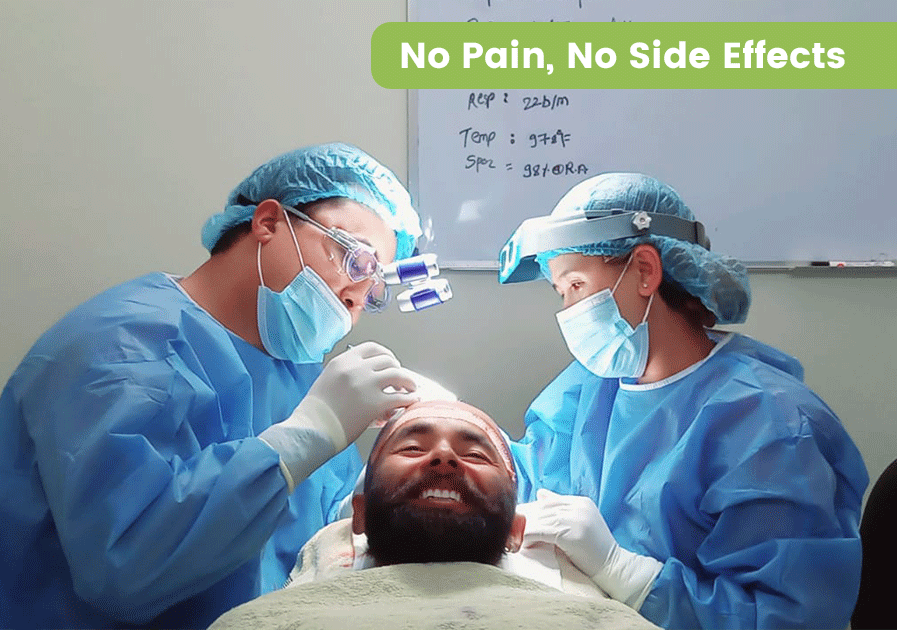
Hair transplantation is a cosmetic procedure which involves the extraction of hair roots from the donor area (back and sides of the scalp) and planting it to the recipient area i.e. bald area. Hair can also be taken from beard, chest, axilla and other body parts.
The basic concept of hair transplantation is based on the principle of ‘donor dominance’. Donor dominance implies that transplanted hair will retain its properties of original site even when moved to a bald area. We know that in pattern hair loss ( Androgenetic alopecia), the area in the front, middle and crown part of the scalp is susceptible to DHT where as back and sides are not. Hair transplantation this follows the concept of transferring DHT immune hairs to the bald areas.
ALOPECIA AREATA
Alopecia areata is the conditions for hair fall in which person’s immune system attack his/her own hair follicles causing hair loss. It presents as smooth circular to oval patches of hair loss over scalp, beard, eyebrows or any other body sites.
ANDROGENETIC ALOPECIA (PATTERN HAIR LOSS)
Androgenetic alopecia also called a pattern hair loss is the most common cause of hair loss in which thick hairs gradually become thin and short because of the byproduct Dihydrotestosterone (DHT) of male hormone testosterone.
It is also called a pattern hair loss because hair loss follows a particular pattern. Male tends to lose hair in the front, crown and middle part of scalp but retain hair at the sides and back of the scalp. These retained hairs has the DHT resistant follicles, are often referred to as the “permanent zone”.
Frequently Asked Questions
Q: What Does The PLATELET RICH PLASMA(PRP) Treatment Do?
A: PLATELET RICH PLASMA(PRP) is used to halt or reverse miniaturization, the process that causes common baldness.
Q: What Does The PLATELET RICH PLASMA(PRP) Treatment Do?
A: PLATELET RICH PLASMA(PRP) is used to halt or reverse miniaturization, the process that causes common baldness.
Q: What Does The PLATELET RICH PLASMA(PRP) Treatment Do?
A: PLATELET RICH PLASMA(PRP) is used to halt or reverse miniaturization, the process that causes common baldness.